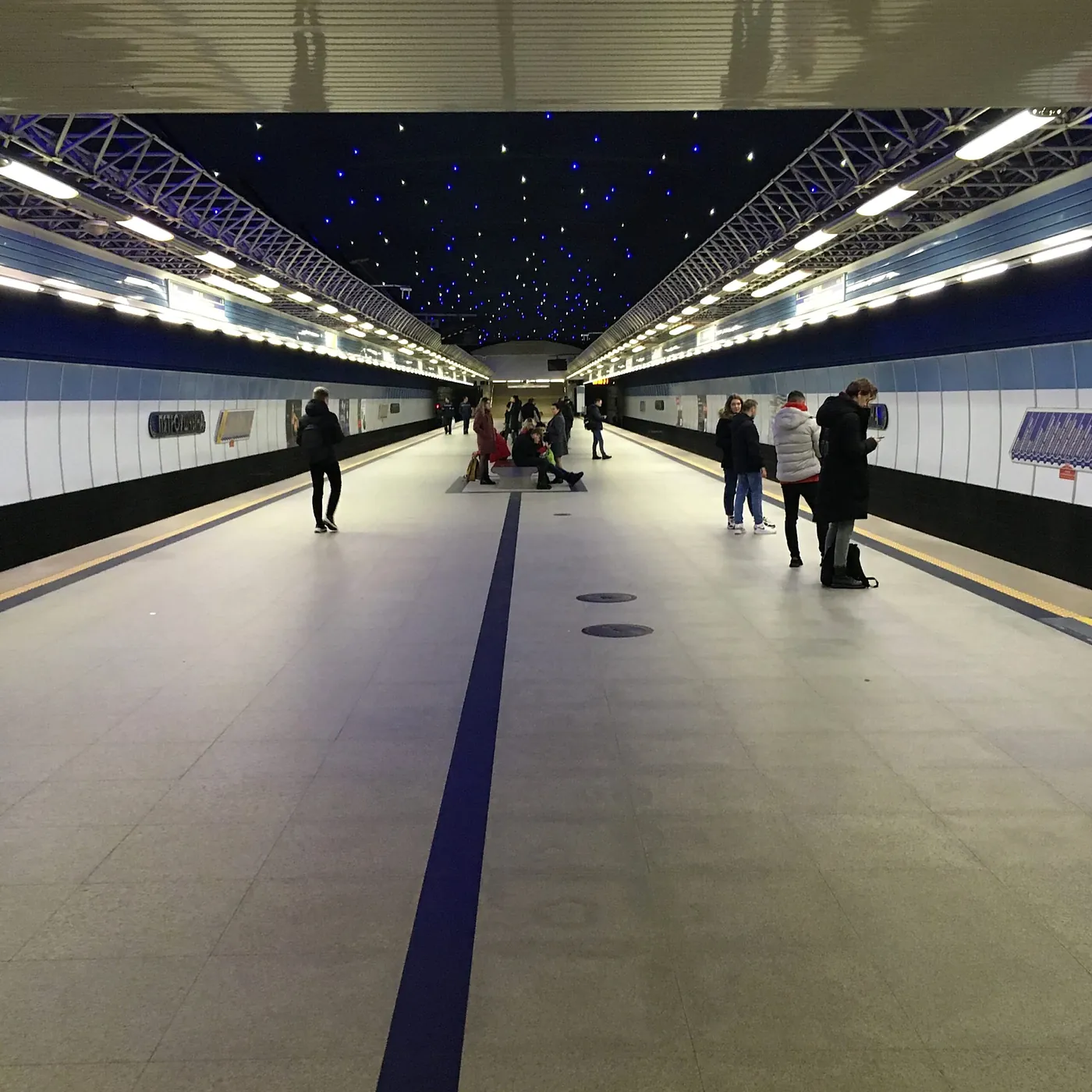
First of all, you can never quite shake off the feeling of being watched. Not that this is particularly unusual in a metro anywhere else in the world, whatever the degree of authoritarian government. It’s just that you suspect that more people are employed to actually look at the videos compared to many other countries. In any case, ‘Big Brother’ (‘is watching you’ ) might send a chill down the spines of those foreigners whose consciousness hasn’t been hijacked by the voyeuristic TV programme. For some Belarusians, it might be vaguely reassuring that somebody is keeping an eye out to nip in the bud any unruly or drunken behaviour. Or perhaps not…
Beware of the Gate
Going through the barrier is also a salutary experience. If you try to get through without paying, or your pass has expired, or your plastic token didn’t go in the first time, then the gates slam shut with all the vengeance of divine retribution as the monitors detect your body illegally passing through. If the barriers catch you in the right place, they create bruises and, well, it serves you right – you ought to do things properly. No matter. People here generally obey the rules because they are naturally law abiding – though the fear of punishment is a useful back-up.
Observe the Rules
In the rush hour, there is a sort of disciplined chaos. Most people accept a priority listing for seating. The old, the infirm, the pregnant and parents with small children (though not necessarily in that order) take precedence. Often the little ones are in first place and the last seat remaining can be rightfully claimed for them. It seems that on a crowded train, a minor is allowed to sprawl over two seats if he or she looks really tired . This elicits no trace of disapproval from the standing crowd.
While a prioritisation of sorts is generally observed, from time to time a teenager may sit determinedly in his or her seat, apparently oblivious to the cohorts of the more deserving who are forced to stand. Even then, the transgressor is usually absorbed in their mobile phone (or occasionally a book), to signal that ‘ I am so distracted with my reading that I didn’t notice old people standing there’ . Or perhaps they want to avoid eye contact with the looks of disapproval beaming down at them.
Inconveniences
In the metro, as everywhere else in the world, we men like to sit with our legs wide apart, perhaps in a blatant attempt to remind women of our main physical difference. The problem always arises if there is three or more men sitting together. The seating area can usually reasonably accommodate their bottoms but there is not enough space to fit in all the spread legs. In this situation, there is a polite, unspoken but nevertheless quiet, determination in a Darwinian struggle for more leg space.
Unlike the case in many western countries, there hasn’t been an outbreak of oversized baby buggies ten times the mass of the baby inside which takes up the equivalent space of five standing people. In fact, there is an almost complete absence of baby buggies – even the collapsible fold-up ones of days gone by. Here, people tend to carry babies instead. Belarusians have not learnt the art of strident entitlement at the expense of others which western buggy owners often demonstrate: Belarus is still a society that endeavors to minimize inconveniencing those around them in public spaces. It can be argued that they have a highly developed social conscience and an awareness of others or it can be that they simply want to avoid the embarrassment of others discretely ‘tut-tutting’ them for being selfish
Its symbolism
The Minsk Metro is a metaphor for society as a whole. It is punctual and reliable. In the rare event that things don’t run to plan and people are inconvenienced, there are no loud exclamations of discontent from passengers as in some countries. Neither are there exchanges of resigned half smiles evoking a spirit of fortitude as in the UK. In fact, there are no outward shows of emotion at all from a society used to philosophically accepting the vicissitudes of life and stoically resigned to its consequences. Fortunately, an almost punctual Minsk metro is one of the few certainties in an otherwise unpredictable life.
Photos from this story
View all 16


Alan Adamou
Writer and researcher focusing on Belarusian history and the families affected by Soviet deportations. His aunt’s memoir, Danuta’s Story, is serialised on this blog.
Thank you for writing this. My great-grandfather was from near Slutsk and the family never spoke about 1920. Reading this finally gave me context for the few things my grandmother hinted at.
Thank you, Siarhei. That silence was very common — people learned it was safer not to talk. If you ever want to share his story, I would be honoured to hear it.
I had never heard of the Slutsk Uprising before. Fascinating and very clearly explained. Is there a good English-language book you would recommend for further reading?
Very little exists in English, sadly. Per Anders Rudling’s ‘The Rise and Fall of Belarusian Nationalism’ is a good starting point.
Seconding that recommendation — it covers the 1918–1921 period in detail.
Жыве Беларусь! It is so important that these stories are told in English too, so the world understands this is not ‘just another part of Russia’.