
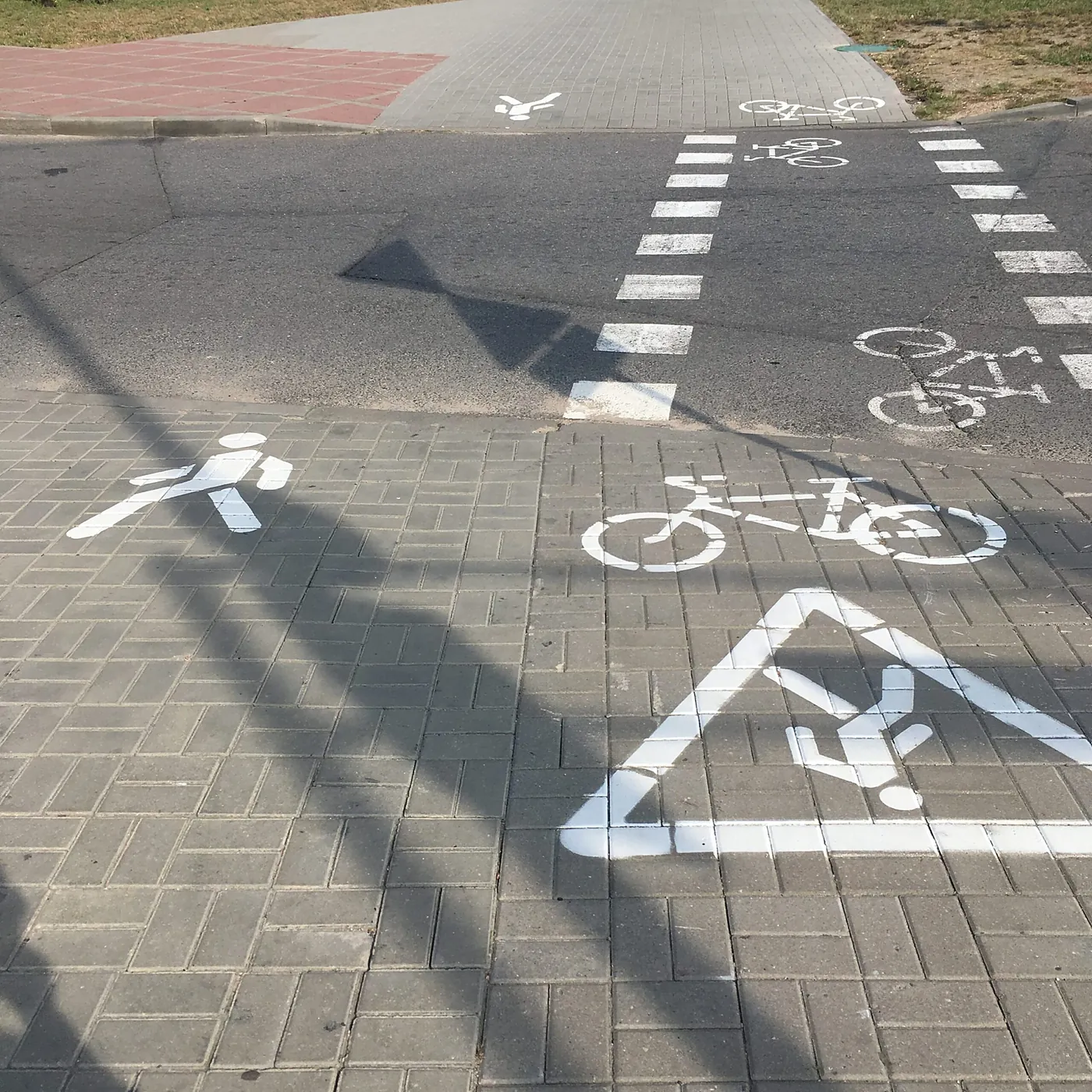
There has been a curious invasion in Minsk. I would like to say ‘of bicycles’, but it’s rather ‘of bicycle lanes’. Yet these bicycle lanes are lacking in bicycles. Perhaps this heralds a potential future renaissance of the bike – an explosion of bicycles to compete with the Netherlands or Denmark?
Well, the difference is that in the Netherlands, the bicycle lanes are sections of the roads. In this way the bicycle runs the risk of competing with errant cars. It is an unequal struggle where, if the bike veers into the car lanes, the car wins. In Minsk – where the bicycle lanes are sections of the pavements – they are at the expense of the pedestrian. It is also an unequal struggle between pedestrian and bicycle, should the pedestrian stray into the bicycle lane. In Minsk, let the pedestrian beware (‘Caveat pedestrem’). The bikes are faster, but even in this case, the stronger may not emerged unscathed after an encounter with an unarmed pedestrian. Unlike cars, bikes can fall over.
It would be nice to think that the mere designation of parts of pavements into bicycle lanes can prompt the emergence of a society of environmentally friendly cyclists. Well, probably not. For a start, Belarus has (or used to have) icier roads than the Netherlands. Here, between December and March the pavements can become slippery and walking on them takes on the role of an extreme sport where one false move can result in a fall and an injury. Sitting atop a bicycle can substantially increase the odds of this happening. Of course, riders can kit themselves out in thick leathers as motorcyclists do, but this is likely to impede movement and increase the chances of falling off. The sight of Minsk streets being peppered with leather-clad Michelin men constantly falling off bicycles would become must-see sight for foreign tourists, but it’s not terribly convenient for getting to work in the mornings. Not as safe as walking or driving and slower than the latter.
So, it’s difficult to see whether those dedicated lanes for bicycles that can take up half the pavement space and a third of the road crossing space may ever entice Belarusians to abandon the cars and flock to two wheels. In the Netherlands, there are approximately 1.3 bicycles per person: an equivalent benchmark in Belarus would amount to 12.3 million bicycles. Even if you include those bicycles in various states of disrepair, pushed out into the balconies, wedged between skis and other seasonally redundant items waiting to be used again, it is unlikely that this figure can be reached.
That’s a pity. If there were so many bicycles in constant use, there would be a practical reason for these bicycle lanes to exist. Until that happens, we pedestrians can continue to walk in those lanes strictly reserved for bicycles, with the assurance that there is very little likelihood of being hit by a bike. However, you’d better be careful look around you. Just in case.
Photos from this story
View all 16


Alan Adamou
Writer and researcher focusing on Belarusian history and the families affected by Soviet deportations. His aunt’s memoir, Danuta’s Story, is serialised on this blog.
Thank you for writing this. My great-grandfather was from near Slutsk and the family never spoke about 1920. Reading this finally gave me context for the few things my grandmother hinted at.
Thank you, Siarhei. That silence was very common — people learned it was safer not to talk. If you ever want to share his story, I would be honoured to hear it.
I had never heard of the Slutsk Uprising before. Fascinating and very clearly explained. Is there a good English-language book you would recommend for further reading?
Very little exists in English, sadly. Per Anders Rudling’s ‘The Rise and Fall of Belarusian Nationalism’ is a good starting point.
Seconding that recommendation — it covers the 1918–1921 period in detail.
Жыве Беларусь! It is so important that these stories are told in English too, so the world understands this is not ‘just another part of Russia’.